
Eslabong Guide · P0
Eslabong Beginner Guide: What to Fix When You Keep Losing
A practical Eslabong beginner checklist for repeated losses, built from current player questions and verified game systems.
Last Verified: 2026-09-08
Fast answer
If you are losing repeatedly, do not rebuild everything at once. First identify whether the losses come from:
- the starting identity of your roster;
- a difficulty setting that is punishing your learning curve;
- weak manual control, spacing or timing;
- a roster problem that autobattle can expose better than direct play.
That sounds obvious, but it is the safest current approach because Eslabong still has many systems that are only partly documented outside the game.
0.36.1 check if you suddenly started losing ranked
If the losses started after September 1, 2026, look at Challenge Tower composition before you blame the starting team.
The official 0.36.1 notes cap ranked teams at one regular fighter per class plus one Champion. Champions do not eat a regular class slot. Ineligible teams keep Elo and records, then become eligible again after you submit a legal roster. Ranked Exhibition exists so you can practice that rebuild without touching rewards.
High-PWR stacks also got quieter: offensive PWR above 600 now keeps 50% efficiency instead of 75%. If your old “just stack PWR” lineup felt weaker overnight, that is the patch, not a hidden bug.
See the patch tracker for the official numbers.
0.40.7–0.40.8 if you wanted PvP practice without ranked rebuilds
If the losses are in Unranked Tower, not ranked: 0.40.7 added Unranked Tower Matches searched by average level and season. 0.40.8 then uses average power when no similar-level teams are available. That queue is separate from the 0.36.1 one-per-class ranked rule. Automatic Weekly Scout costs 2,000 gold and adds scouted fighters of the chosen class.
The Rookie Development Cup (renamed from Newbie Tournament in 0.40.8) is a late-game leveling cup: 2,000 Gold, no injuries, 600 XP per registered fighter including reserves.
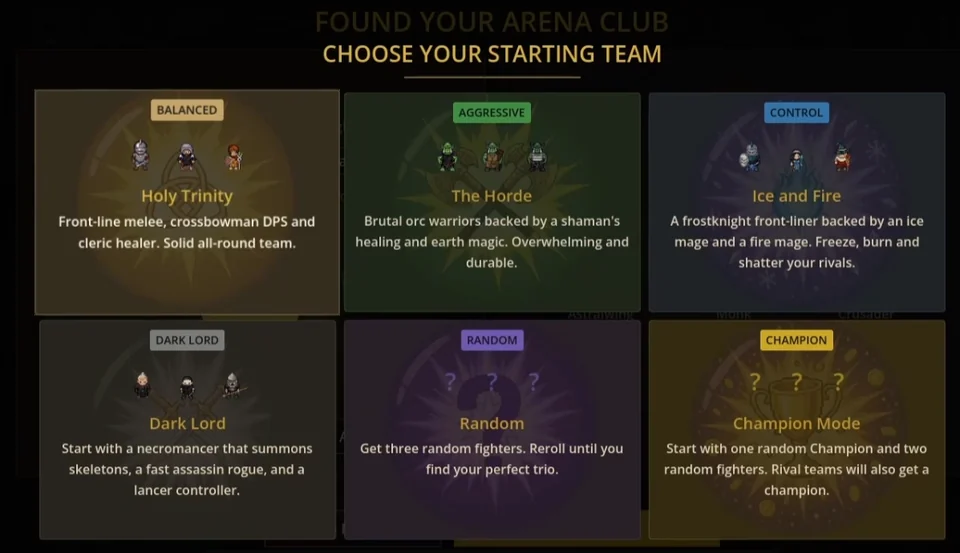
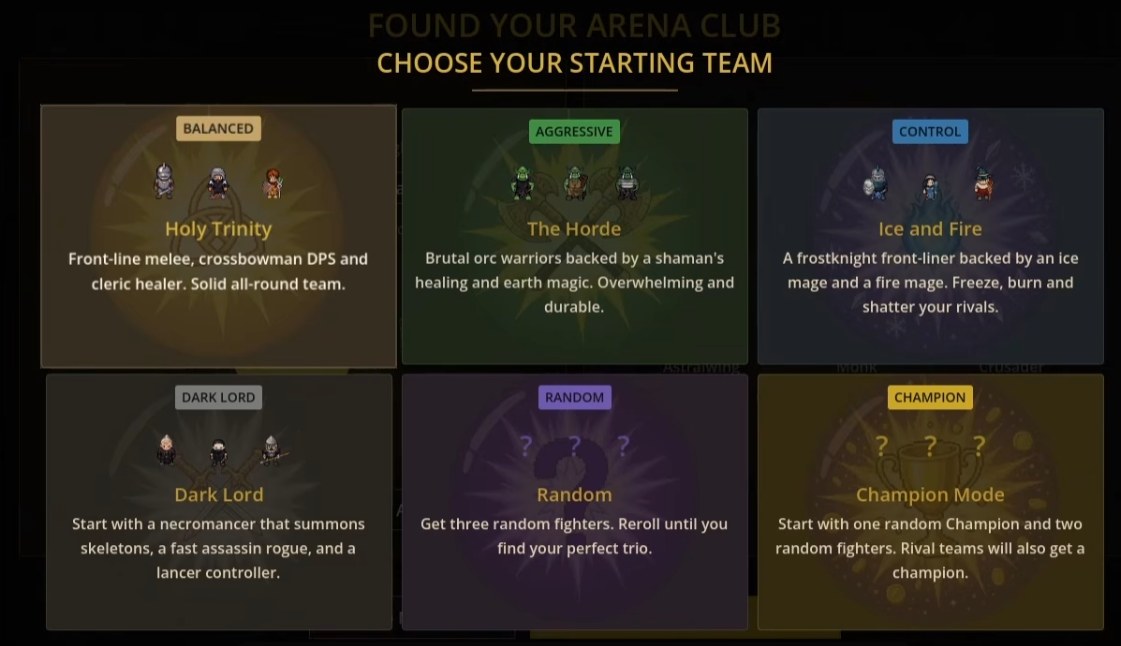
The current starting-team screen is one of the most useful “first diagnosis” screens because it tells you what style of roster you actually started with.
1. Check the starting identity of your roster
The current start screen shows six opening choices: Holy Trinity, The Horde, Ice and Fire, Dark Lord, Random, and Champion Mode.
Those names matter because they imply very different learning experiences:
- Holy Trinity is presented as a balanced all-round team.
- The Horde is framed as aggressive and durable.
- Ice and Fire is framed around control, freeze and burn pressure.
- Dark Lord introduces summons and a less straightforward opener.
- Random is for experimentation, not predictable onboarding.
- Champion Mode changes the opening structure entirely.
If you chose a more specialized opener and are losing, that does not automatically mean the roster is weak. It may simply mean you started with a less forgiving learning path.
2. Use the tutorial as a benchmark, not just a formality
The current Preseason tutorial labels its opening lesson Match 1/4 — Lone Skeleton and explicitly says the goal is to learn movement, spacing and timing.
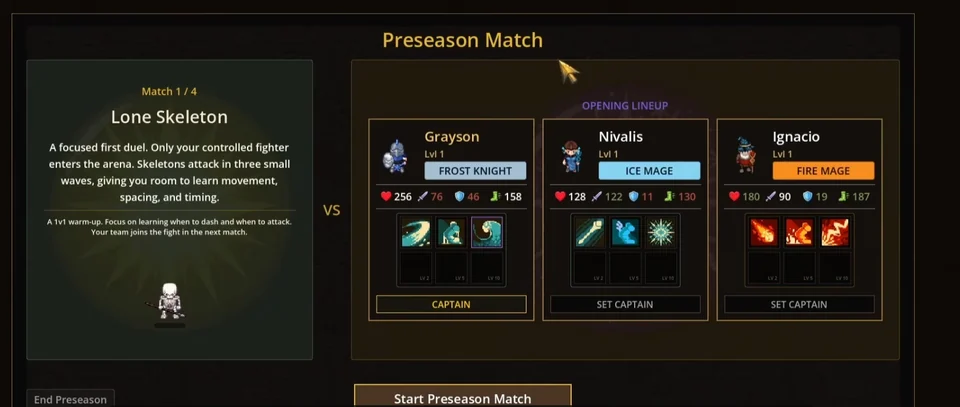
This tutorial screen is important evidence because it shows what the game itself considers the first mechanical lesson.
Before blaming your roster, ask whether you can already do the following consistently:
- move without overcommitting;
- dash at the right moment instead of panic-spamming;
- attack when you have space rather than into pressure;
- recognize when a loss is caused by execution rather than team composition.
If not, keep your diagnosis simple: you may still be in the “learn the controls” stage rather than the “solve the metagame” stage.
3. Learn one combat mode before judging your whole team
Eslabong officially supports both direct Captain control and autobattle. That means you can learn in two different ways.
Use manual control when:
- you want to improve spacing or timing;
- you think your own actions can save a close fight;
- you are trying to understand one matchup in detail.
Use autobattle when:
- you want to see how the roster behaves without your own execution muddying the result;
- you suspect the team has role overlap, poor durability or weak damage pacing;
- you want to compare “how the roster performs” versus “how I perform”.
This is one of the safest current player workflows because it uses officially supported systems instead of invented hidden formulas.
Check tactics after 0.33.1 (Advanced Tactics)
Since the August 28 patch, Advanced Tactics exist for two axes: AOE Efficiency (Natural / Requires 2 / Requires 3) and Friendly Fire (Natural / Avoid / Calculated / They Will Dodge). Each personality has a default — Reckless uses They Will Dodge, Cautious uses Avoid — and a specific tactic setting always overrides personality. If you keep losing to self-inflicted damage or wasted area damage, check these before blaming your roster. Also note 0.33.11 renamed Attack to Power in all languages, so older mentions of ATK now read PWR.
4. Use difficulty as a learning tool, not as an ego test
The current difficulty screen confirms four options: Relaxed, Normal, Hard and Infernus.
- Relaxed gives Double Gold and Double Renown, with slower enemy progression and weaker Champions/Bosses.
- Normal is the intended baseline.
- Hard keeps gold at the Normal level but makes rivals stronger/faster and keeps injuries active.
- Infernus is the most demanding option shown.
If you are trying to understand the Market, lineups and pacing, Relaxed is a valid sandbox. If you want to compare your results against the intended baseline, use Normal.
5. Separate current evidence from community overconfidence
Steam discussions are useful because they reveal what players are struggling with right now. That is great for choosing topics, but it is not enough to publish a fake “best team” or “best class” answer.
So the safest current beginner loop is:
- choose a starting team whose identity you understand;
- use the tutorial to check spacing/timing basics;
- compare manual play versus autobattle;
- lower or reset difficulty if you are learning systems, not proving a point;
- only then start changing the roster.
What we are deliberately not claiming
This page does not publish:
- an unverified tier list;
- hidden damage formulas;
- a guaranteed winning formation;
- a full current tactics-setting guide.
Those topics need a stronger current Codex export and more live-build evidence.
Q&A
Why do I keep losing in Eslabong?
Repeated losses usually come from a bad fit between starting roster, difficulty, control mode and your current understanding of spacing or targeting. Test one variable at a time.
Is there one best beginner team?
No universal best beginner team is verified. The current build presents several clearly different starting presets, so the safest choice depends on what style you want to learn first.
Should I use autobattle?
Yes, as a diagnostic tool. Watch autobattle to spot positioning or roster issues, then switch to manual control to test whether your inputs change the result.
Can I lower the difficulty?
Yes. Relaxed is a valid learning option because the current screen explicitly changes gold, renown and enemy progression.
Sources & verification
- official Steam Store — Eslabong · 2026-08-26
- player Steam Community discussions · 2026-08-26
- video Current gameplay capture supplied by user — Starting Team screen · 2026-08-26
- video Current gameplay capture supplied by user — Preseason Match 1/4 · 2026-08-26